Dutch Winter Cross Stitch: Skaters, Windmills and Snow
Frozen canals, skaters, windmills in the snow and a koek-en-zopie on the ice. A guide to the Dutch winter cross stitch kits and Paint by Numbers designs, and what you are actually...
Featured
 Your Photo – Color by Number$63.00
 Custom Embroidery Kit of Your Photo$38.00
 Urban Charm – Paint by Numbers Set (2 canvases)$76.00
 Rural Dream - Paint by Number Kit (2 canvases)$76.00
 Sunset Dreams - Paint by Number Kit (2 canvases)$76.00
 Girl with a Pearl Earring – Johannes Vermeer – Paint by Numbers$63.00
Cross stitch for beginners made simple: supplies, your first stitch, common rookie mistakes, and how to pick a pattern you'll actually finish.
Last updated: 6 May 2026 — by Stitchi Studio
Cross stitch for beginners is one of the most forgiving crafts you can pick up. You only need to learn one stitch, the supplies are inexpensive, and within an evening you can finish a small piece you're genuinely proud of. This guide walks you through everything: what to buy, how to make your first stitch, the rookie mistakes that frustrate new stitchers, and roughly how long your first project will take. By the end, you'll have a clear plan to start tonight without buying anything you don't need.
Cross stitch is a form of counted embroidery where you make small X-shaped stitches on an evenweave fabric (almost always Aida for beginners). Each X corresponds to one square on a printed chart. Follow the chart, count the squares, fill them in with the right color of floss — that's the entire craft.
Unlike free-hand embroidery, you don't need to draw, trace, or improvise. The pattern tells you exactly where every stitch goes. That's why so many people who don't think of themselves as "crafty" end up loving it. If you can count and you can recognize colors, you can cross stitch.
The hobby has been around for centuries, but modern cross stitch covers everything from minimalist line-art and snarky quotes to photo-realistic portraits. Once you've learned the basic technique, you can stitch almost any image — including a custom photo cross stitch kit made from one of your own pictures.
Don't overthink your shopping list. Here's the complete kit, with no fluff:
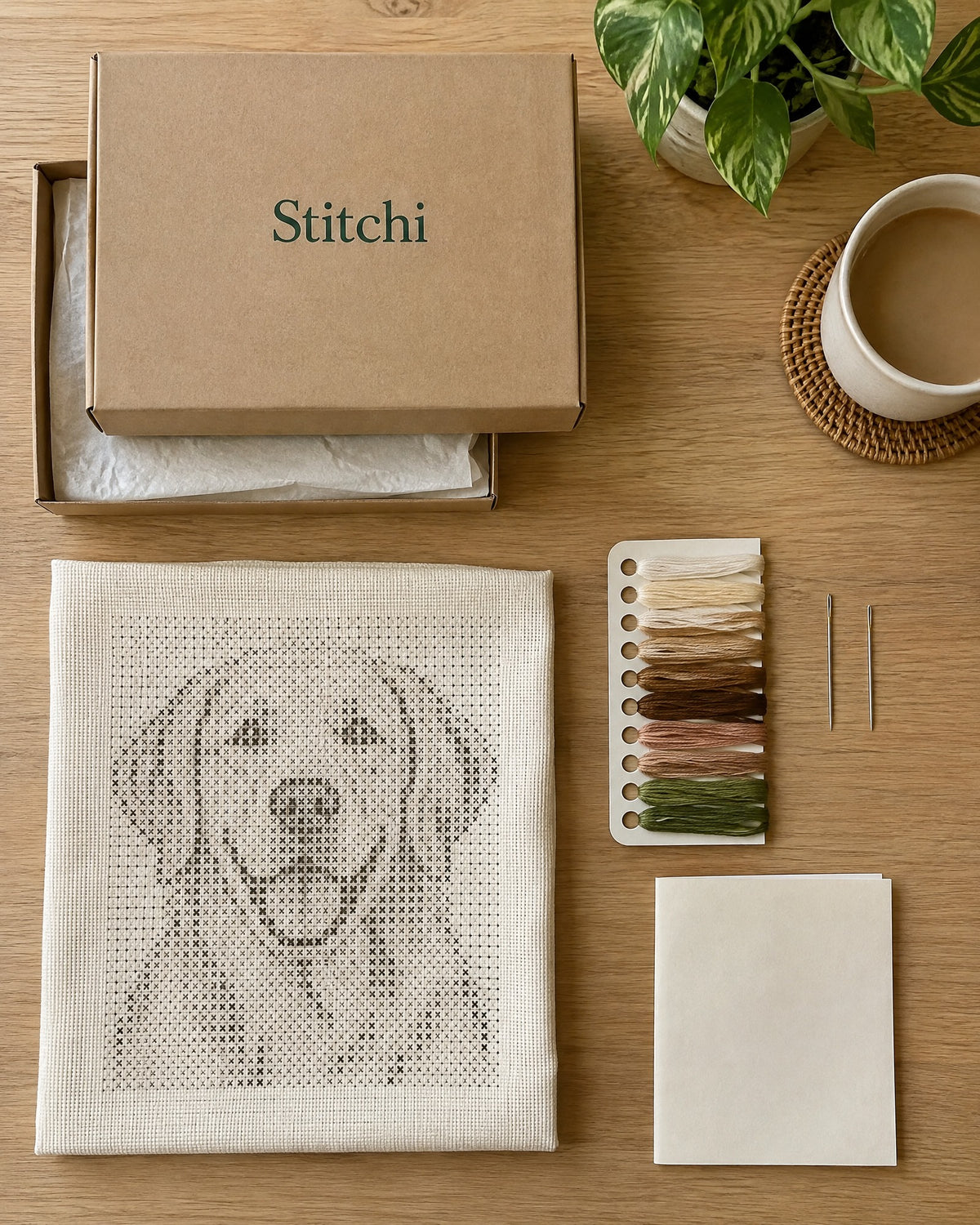
If you'd rather not source these items separately, a starter kit gives you everything matched and ready in one box.
Many patterns also call for backstitch lines (outlines, lettering, fine detail) once your X's are complete. Our backstitch tutorial covers that next step in full.
If you remember nothing else from this guide, remember this. Every X you stitch must have its top leg pointing the same way. The standard is bottom-left to top-right on the bottom, then bottom-right to top-left on top — so the top leg goes from bottom-right up to top-left ( \ over / ).
Why does it matter? Because light reflects off floss differently depending on direction. If half your crosses go one way and half go the other, the finished piece looks patchy and amateur, even when every count is correct. Pick a direction the moment you start. Don't switch.
If you catch yourself going the wrong way three stitches in, pull them out now. If you catch it 200 stitches in, finish the section the new way and call it a design choice. Don't ruin a finished piece chasing perfection.
The pattern you pick decides whether you finish or quit. Here's what works for a first project:
If you're not sure how to read the chart, our walkthrough on how to read a cross stitch pattern covers symbols, the legend, and counting.
An honest range: 6 to 15 hours of stitching for a first piece around 60 x 60 stitches. Beginners average roughly 100 stitches per hour. With practice, that climbs to 200 or 300.
To put numbers on it: a small 80 x 80 piece is 6,400 stitches. At 150 per hour, that's about 42 hours of stitching. Spread over evenings, that's a four-to-six-week project. For a deeper look at how project size translates to hours, see our cross stitch pattern sizes guide.
This slowness is the point. Cross stitch is a deliberately calm hobby. If you're curious about the mental side, our piece on mindful cross stitch and anxiety relief goes into the wellbeing research.
Once you've finished a piece, you'll need to decide what to do with it — frame it, mount it, or leave it in the hoop. Our guide on how to finish a cross stitch project covers all four options.
Once you've completed a piece or two, you'll discover cross stitch makes an exceptional personal gift — one of the few crafts where the recipient genuinely feels the time invested. Per-occasion guides:
No. Cross stitch is counted, not freehand. The chart tells you where every stitch goes. If you can count squares and recognize colors, you can do it. People who can't draw a stick figure stitch beautiful pieces every day.
Most kids can manage cross stitch from about age 8 with a child-sized hoop and a low-count fabric. Younger children can do plastic-canvas projects. We have a full breakdown in our guide on cross stitch with kids.
Yes — evenweave linen, hardanger, and waste canvas all work. But for your first 5 or 10 projects, stick with Aida. The grid is bigger and clearer, which removes the biggest source of beginner frustration.
The four classic options are: frame it behind glass, mount it on stiff board, leave it in the embroidery hoop as wall art, or sew it into a pillow or pouch. The right choice depends on the piece, the room, and your patience for finishing work.
A complete starter kit runs about 25 to 40 USD. Buying components separately costs roughly the same once you've added fabric, six skeins of floss, a hoop, a needle, scissors, and a pattern. Your second and third projects cost a fraction of the first because you reuse the hoop, scissors, and needles.
Pick a small pattern, grab a starter kit, and give yourself one quiet evening. Don't aim to finish — aim to enjoy the first hour. If you want to make your first project genuinely personal, our custom photo cross stitch kit turns one of your own photos into a complete pattern with all the floss and fabric included. For more reading, our guides on Aida cloth count and how to read a pattern are the natural next steps.
Choose a photo you treasure and see your preview straight away. We’ll turn it into a complete Paint by Numbers kit.


Frozen canals, skaters, windmills in the snow and a koek-en-zopie on the ice. A guide to the Dutch winter cross stitch kits and Paint by Numbers designs, and what you are actually...
How the two-canvas duo set works, how to choose between up to 20, 30 and 40 colours, and which of the 75 Christmas Paint by Numbers designs suits whom.
Choose the motif first, then the size, then the canvas type. A practical walk through the 52 Christmas cross stitch designs, with sizes, what is in the box and what it costs.

