Dutch Winter Cross Stitch: Skaters, Windmills and Snow
Frozen canals, skaters, windmills in the snow and a koek-en-zopie on the ice. A guide to the Dutch winter cross stitch kits and Paint by Numbers designs, and what you are actually...
注目の商品
 あなたの写真で作る数字ぬりえ¥10,000
 写真からつくるオーダーメイド刺しゅうキット¥6,000
 街の魅力 — 数字ぬりえセット(キャンバス2枚)¥12,000
 田園の夢 — 数字ぬりえセット(キャンバス2枚)¥12,000
 夕日の夢 — 数字ぬりえセット(キャンバス2枚)¥12,000
 真珠の耳飾りの少女 — ヨハネス・フェルメール — 数字ぬりえ¥10,000
Photo to cross stitch pattern made simple: which photos work best, how the conversion handles colors, and what size produces the best detail.
Last updated: 6 May 2026 — by Stitchi Studio
Turning a photo into a cross stitch pattern is the most personal thing you can do with this craft. A wedding photo, a child's portrait, a beloved pet, a grandparent's face — converted into a stitched piece that lasts for generations. But not every photo converts well, and the difference between a stunning result and a muddy one comes down to a handful of choices made before the first stitch. This guide walks through which photos work best, how the conversion process actually handles color, what size produces the right level of detail, and how to set yourself up for a finished piece you'll want to hang on the wall.
A photo cross stitch pattern is a chart generated by converting a digital photograph into a grid of cross stitches. Specialized software analyzes the photo, maps each region to the closest match in the embroidery floss palette, and outputs a pattern showing which color goes in which square. You stitch the result like any other counted cross stitch chart — except the finished piece is a recognizable image of someone or something you love.
Done well, the result looks startlingly close to the original photograph. Photo cross stitch is the modern face of an old craft — it's the technique behind the photo-realistic portraits that have brought a younger generation back to embroidery. For more on this trend, see our cross stitch trends 2026 piece.
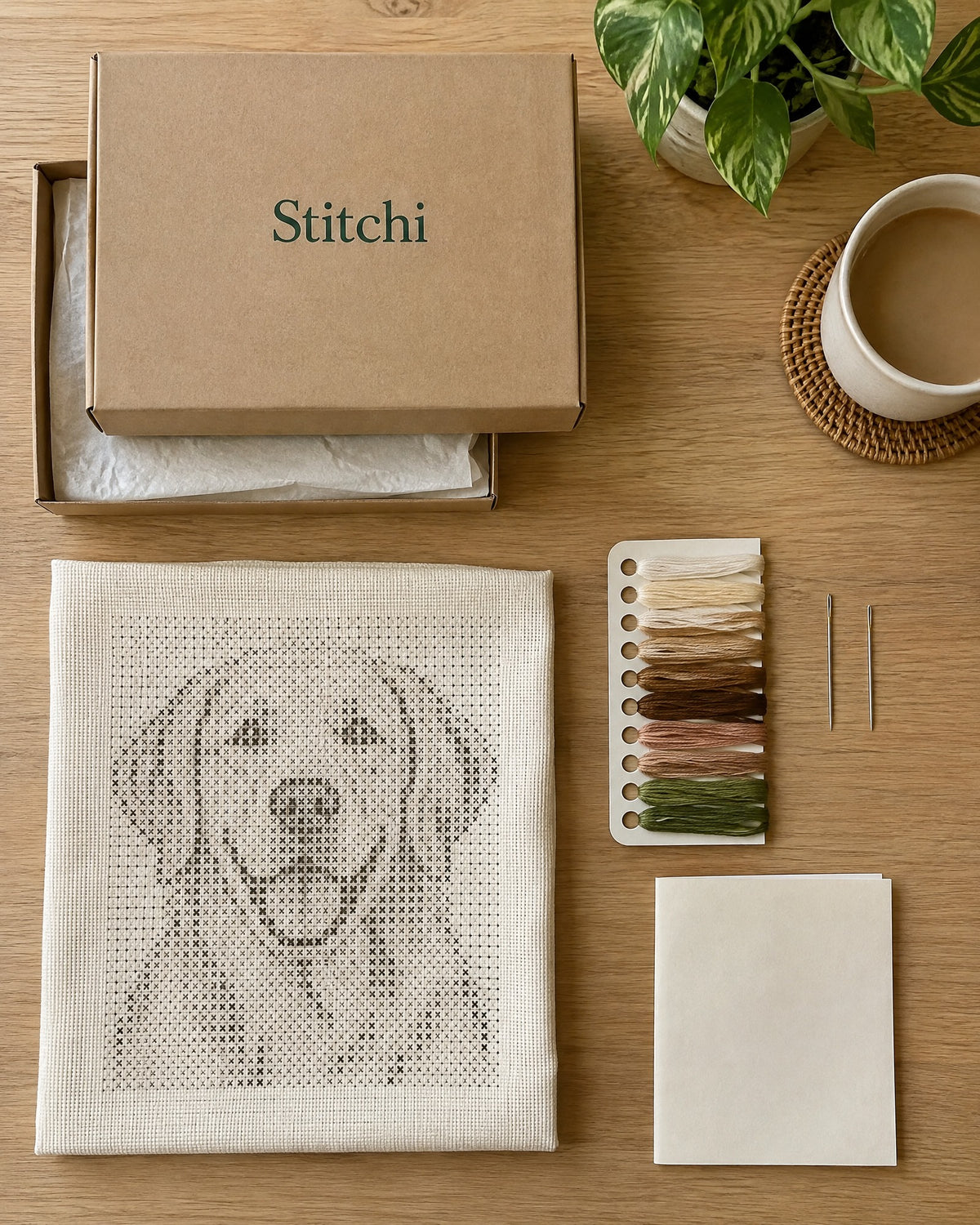
The hardest part is no longer the conversion itself — a good custom photo cross stitch kit handles all the technical work and ships with the finished pattern, fabric, floss, hoop, and needle ready to go. The harder part is choosing the right photo.
Not every photo converts cleanly. The mechanics of cross stitch favor specific photo qualities.
Cross stitch reads from across a room. If your photo is a soft pastel from edge to edge, the finished piece will look hazy and indistinct. Look for photos with clear darks and clear lights — a face with shadow on one side, a pet against a contrasting background, a building with a bright sky behind.
One subject. Cluttered group shots and busy landscapes don't translate. The eye needs somewhere obvious to land.
Natural daylight (window light, golden hour outdoors) gives skin tones and fur the kind of dimensional shadow that converts beautifully. Harsh flash or back-lit silhouettes flatten the subject in conversion.
The conversion software needs detail to work with. A blurry phone photo from 2014 will produce a blurry stitched piece. Aim for at least 1500 pixels on the long edge.
If your photo isn't ideal, that's solvable. A good photo cross stitch service will crop and adjust the image before conversion. Send the highest-resolution version you have.
The conversion happens in three steps:
Behind the scenes, the smart bit is the color reduction. Picking the wrong 50 colors will turn a vibrant photo into mud. Picking the right 50 produces a result so close to the original that people lean in to check whether it's a print or stitched. This is also why photo cross stitch costs more than buying a pre-made pattern — every kit's color palette is unique to your image. Our custom photo cross stitch kit uses an optimized conversion process refined over hundreds of customer photos.
For most photos, 30 to 60 thread colors is the sweet spot.
The right number depends on the photo. A high-contrast pet portrait with a plain background might shine at 25 colors. A wedding portrait with an intricate dress and floral background might need 55. The conversion software (or a good kit maker) will pick the right count automatically. The Embroidery floss color chart guide explains why these numbers aren't sequential.
Detail in cross stitch comes from stitch count, not magic. A bigger pattern shows more detail.
| Pattern size (stitches) | Finished size on 14ct | Detail level | Best for |
|---|---|---|---|
| 100 x 125 | ~7 x 9 inches | Stylized, low | Pet silhouettes, simple subjects |
| 150 x 200 | ~11 x 14 inches | Recognizable | Single subject, plain background |
| 200 x 250 | ~14 x 18 inches | Strong detail | Portraits, pets, single faces |
| 250 x 350 | ~18 x 25 inches | Photo-realistic | Wedding portraits, large pieces |
| 350 x 500 | ~25 x 36 inches | Heirloom-grade | Multi-subject, gallery-size |
For a portrait, 200 x 250 is the minimum where individual facial features (eyes, mouth) read clearly from across a room. Below that, faces start to look generic. The Aida cloth count guide has the math for picking fabric size.
Honest numbers. Most stitchers manage 150 to 300 stitches per hour.
If those numbers shock you: that's the point. A photo cross stitch is a serious commitment. The reward is a piece that looks like nothing else — and you're spending those hours in a calm, focused state. See our piece on mindful cross stitch for why those hours don't feel like "work."
For a more manageable first project, start with a 100 x 125 simple subject. Build skill, then commit to a portrait.
Almost. Photos with clear subjects, strong contrast, and good lighting convert well. Blurry, low-resolution, or heavily filtered photos produce muddy results. If you're unsure, send your photo — a good kit maker will tell you honestly whether to pick a different one.
Range varies widely. Small kits (100 x 125) start around 35-50 USD. Medium kits (200 x 250) sit around 70-100 USD. Large heirloom kits run 120-200 USD. The cost reflects the unique pattern generation, custom-counted floss, and matching fabric.
It will look like a stitched version of your photo — recognizable, dimensional, and beautiful, but with the texture and slight color simplification that defines the medium. Many people describe the result as feeling more emotional than the original photo because of the time invested.
If the photo is the only one you have of someone important, yes — with caveats. Detail can't be invented. The conversion will be cleaner if the original is sharp. For very precious low-res photos, ask if the kit maker offers manual touch-up.
Visit our custom photo cross stitch kit page, upload your photo, choose your size, and we handle the conversion, palette selection, and supply matching. The complete kit ships within a few business days, ready to stitch.
Pick the photo, check it for contrast and lighting, and order. Our custom photo cross stitch kit handles every technical step and ships with everything you need to start the same day it arrives. For occasion-matched ideas, see our pieces on personalized cross stitch gifts, baby gifts, wedding gifts, and Mother's Day.
大切な写真を選ぶと、すぐにプレビューが表示されます。その写真を、すべてそろった数字ぬりえキットにしてお届けします。


Frozen canals, skaters, windmills in the snow and a koek-en-zopie on the ice. A guide to the Dutch winter cross stitch kits and Paint by Numbers designs, and what you are actually...
How the two-canvas duo set works, how to choose between up to 20, 30 and 40 colours, and which of the 75 Christmas Paint by Numbers designs suits whom.
Choose the motif first, then the size, then the canvas type. A practical walk through the 52 Christmas cross stitch designs, with sizes, what is in the box and what it costs.

