Dutch Winter Cross Stitch: Skaters, Windmills and Snow
Frozen canals, skaters, windmills in the snow and a koek-en-zopie on the ice. A guide to the Dutch winter cross stitch kits and Paint by Numbers designs, and what you are actually...
À la une
 Votre photo – Peinture par numéros€54,95
 Eigen Foto Borduurpakket€32,95
 Stadse Charme – Kleuren op Nummer Set (2 canvassen)€65,95
 Landelijke Droom – Kleuren op Nummer Set (2 canvassen)€65,95
 Zonsondergang Dromen – Kleuren op Nummer Set (2 canvassen)€65,95
 Meisje met de Parel – Johannes Vermeer – Kleuren op Nummer€54,95
Cross stitch with kids: from what age, which kit fits which age, and how to keep them motivated. Practical guide for parents and grandparents.
Last updated: 6 May 2026 — by Stitchi Studio
Cross stitch with kids is one of the most underrated screen-free activities for the 8-and-up age range. It develops fine motor skills, builds patient focus, and ends with a finished piece a child can be genuinely proud of — the same self-confidence boost as building a model or finishing a long puzzle, but more portable and cheaper. This guide covers the right age to start, which kits suit which age range, the material adjustments that make stitching easier for small hands, how to run a successful first session, and what to do when the kid hits the inevitable mid-project boredom wall.
Most children can manage cross stitch from age 8, when fine motor skills are reliable enough to handle a needle and the patience to count squares is developed. Some kids start as early as 6 with a simplified setup; others won't be ready until 10. Watch for these signs:
Younger children (4-7) can do plastic-canvas projects — a stiffer plastic mesh that's easier to stitch and impossible to crumple. The fine-motor benefits are similar; the safety bar is much lower.
For our wider beginner content, the starter guide covers cross stitch for adults and assumes more independence.
Why pediatricians and occupational therapists recommend stitching:
Holding a needle, threading floss, and pushing through fabric exercises the same finger muscles used in handwriting. Kids who do regular handwork tend to have better pen grip and clearer letter formation.
The structured nature of cross stitch — one stitch at a time, follow the chart — trains kids to settle into a single task for extended periods. This is the same focus skill that translates to reading, math, and music practice.
Modern kids' default downtime is screens. Cross stitch is the rare alternative that's portable, quiet, and produces a finished object. Many parents report kids choosing stitching over a tablet within a few weeks of starting.
A finished cross stitch is a tangible result. The frame goes on the wall. Adults compliment it. The kid notices the difference between a finished thing and a half-built thing — a useful life lesson.
Stitching is one of the very few hobbies a 9-year-old and an 80-year-old can do side-by-side. Grandparents who stitch report deep value in the shared activity.
| Age | Best kit specs | Project size |
|---|---|---|
| 8-10 | 11-count Aida, 4-6 colors, large blunt needle | Under 40 x 40 stitches |
| 11-13 | 14-count Aida, 8-12 colors, regular tapestry needle | 50 x 70 stitches |
| 14+ | 14-count Aida, 12-25 colors | 80 x 100 stitches and up |
Always start one step easier than you think the kid can handle. A finished simple piece beats an abandoned hard one. The Aida cloth count guide explains why lower counts are easier for small hands.
Avoid kits with: more than 12 colors (frustrating to track), fractional stitches (too fiddly), backstitch outlines (hard for kids to do cleanly), or finished pieces over 6 x 6 inches (too long-term).
Some small swaps make a big difference.
How to make session #1 a success.
Want to learn how to read the chart yourself first? Our guide to reading cross stitch patterns has the basics.
Most kids hit a motivation wall around the 30%-complete mark. Tactics that work:
If your kid finishes a small kit and wants more, the embroidery hoop size guide walks through what to scale up to next.
Most kids can start at 8 with a simplified setup. Some bright, focused 6-year-olds can manage with adult help. Below 6, plastic canvas (a stiffer mesh) is the safer alternative.
Aim for a piece that takes 6-10 hours total. That breaks into 12-20 short sessions over a few weeks. Anything longer risks abandonment.
Yes, with light supervision. Tapestry needles are blunt by design — they push through pre-made holes in Aida rather than piercing fabric. The biggest risk is a needle dropped onto the floor; teach kids to put the needle into the fabric edge whenever they pause.
Indirectly. Cross stitch builds the same fine motor strength and pencil-grip muscles. Kids who stitch tend to have better pen control, but you'll see the gain over months, not weeks.
Often yes — children's pattern recognition is sharp and they're not yet self-conscious about mistakes. Many kids stitch faster and more cleanly than the adult who's teaching them by week three.
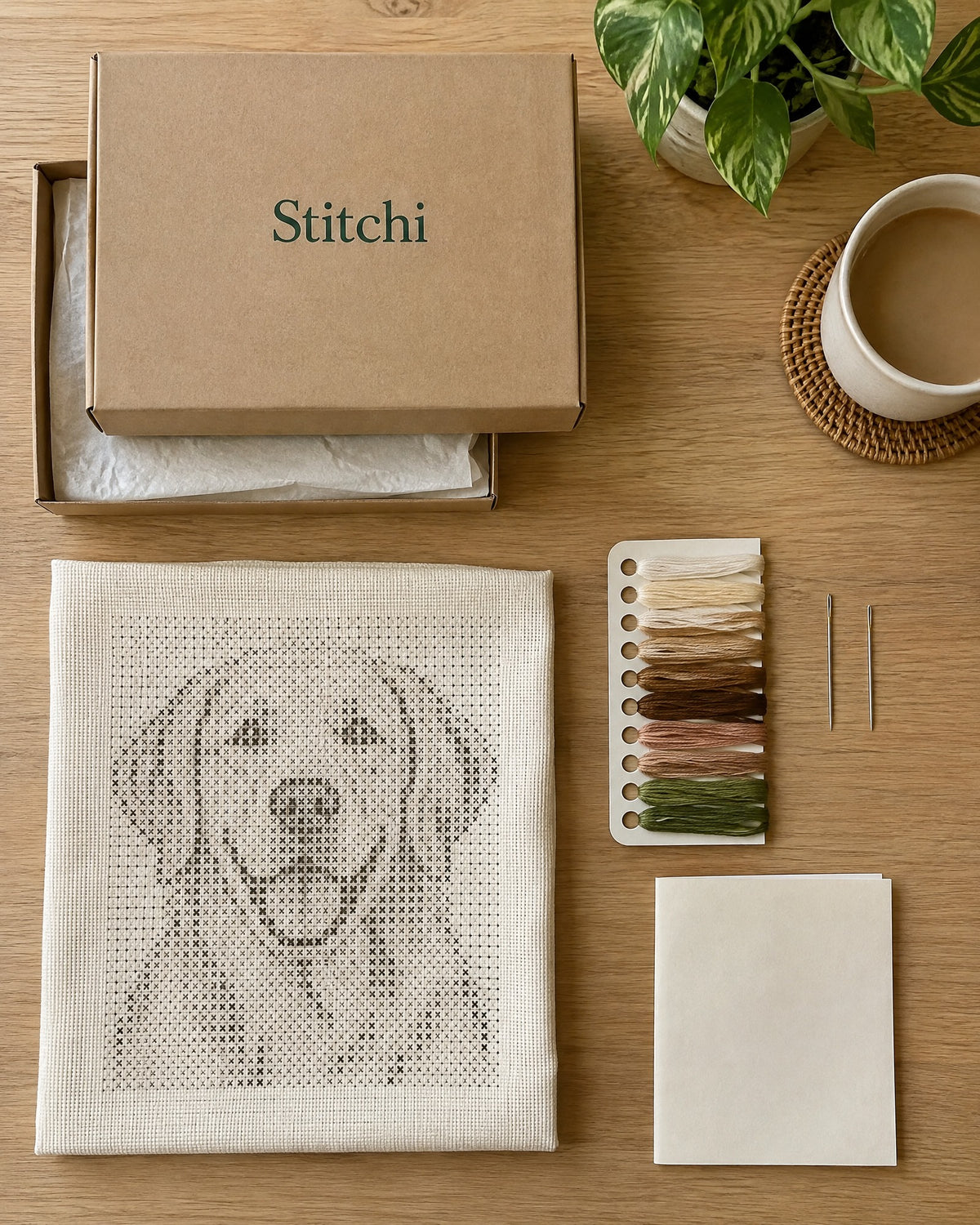
Pick a small, simple kit (under 50 x 50 stitches, under 6 colors), set up beside your kid, and demo the first stitches yourself. For a piece they'll be especially proud of, our custom photo cross stitch kit can convert a photo of their pet, their best friend, or their favorite holiday into a kit just for them. For more on the basics, see our starter guide and the Aida cloth count guide.
Choisissez une photo qui vous est chère et voyez tout de suite votre aperçu. Nous en faisons un kit complet de Peinture par numéros.


Frozen canals, skaters, windmills in the snow and a koek-en-zopie on the ice. A guide to the Dutch winter cross stitch kits and Paint by Numbers designs, and what you are actually...
How the two-canvas duo set works, how to choose between up to 20, 30 and 40 colours, and which of the 75 Christmas Paint by Numbers designs suits whom.
Choose the motif first, then the size, then the canvas type. A practical walk through the 52 Christmas cross stitch designs, with sizes, what is in the box and what it costs.

