Dutch Winter Cross Stitch: Skaters, Windmills and Snow
Frozen canals, skaters, windmills in the snow and a koek-en-zopie on the ice. A guide to the Dutch winter cross stitch kits and Paint by Numbers designs, and what you are actually...
Featured
 Your Photo – Color by Number£47.00
 Custom Embroidery Kit of Your Photo£29.00
 Urban Charm – Paint by Numbers Set (2 canvases)£57.00
 Rural Dream - Paint by Number Kit (2 canvases)£57.00
 Sunset Dreams - Paint by Number Kit (2 canvases)£57.00
 Girl with a Pearl Earring – Johannes Vermeer – Paint by Numbers£47.00
How big should your cross stitch project be? Time investment, ideal wall sizes, and what fits where — a practical guide to choosing project dimensions.
One of the most underrated decisions in cross stitch is project size. Pick too small and your wall art looks meek. Pick too big and you abandon it halfway through. This guide breaks down what each size actually means — in time, in wall presence, and in finished impact.
Two numbers matter: stitch count (how many X's wide and tall) and finished size (in cm or inches). The relationship depends on the fabric count:
So 140 stitches wide on 14ct = 10 inches = 25.4 cm. The same 140 stitches on 18ct = 7.8 inches = 19.8 cm.
Rough estimates assuming average density (about 60% of squares stitched):
Photo-realistic kits sit at the upper end because they're typically 90%+ stitched. Botanical or minimalist patterns are at the lower end.
15×20 cm — you want to finish, not maintain motivation through 80 hours. A small kit completed in 2–3 weeks builds the confidence to tackle bigger.
20×25 cm or 25×35 cm — fits between other artworks without dominating.
40×50 cm or larger — needs presence to balance the furniture below.
7×7 to 10×10 cm — perfect for ornaments, gift tags, mini frames.
Minimum 30×40 cm to capture facial detail. 40×50 cm if you want recognition from across the room.
Cross stitch reads differently than a print. Up close, every X is visible; from far away, it merges into image. A general rule:
An average stitcher: 40–80 stitches per hour. Skilled stitchers hit 100–150 in flow. So a 100×140 design (14,000 stitches if fully stitched) takes 90–350 hours depending on speed and stitch density.
The difference between 30×40 cm and 40×50 cm sounds small. In stitch time it's about double. Pick the size based on time you can realistically invest, not the wall space you imagine.
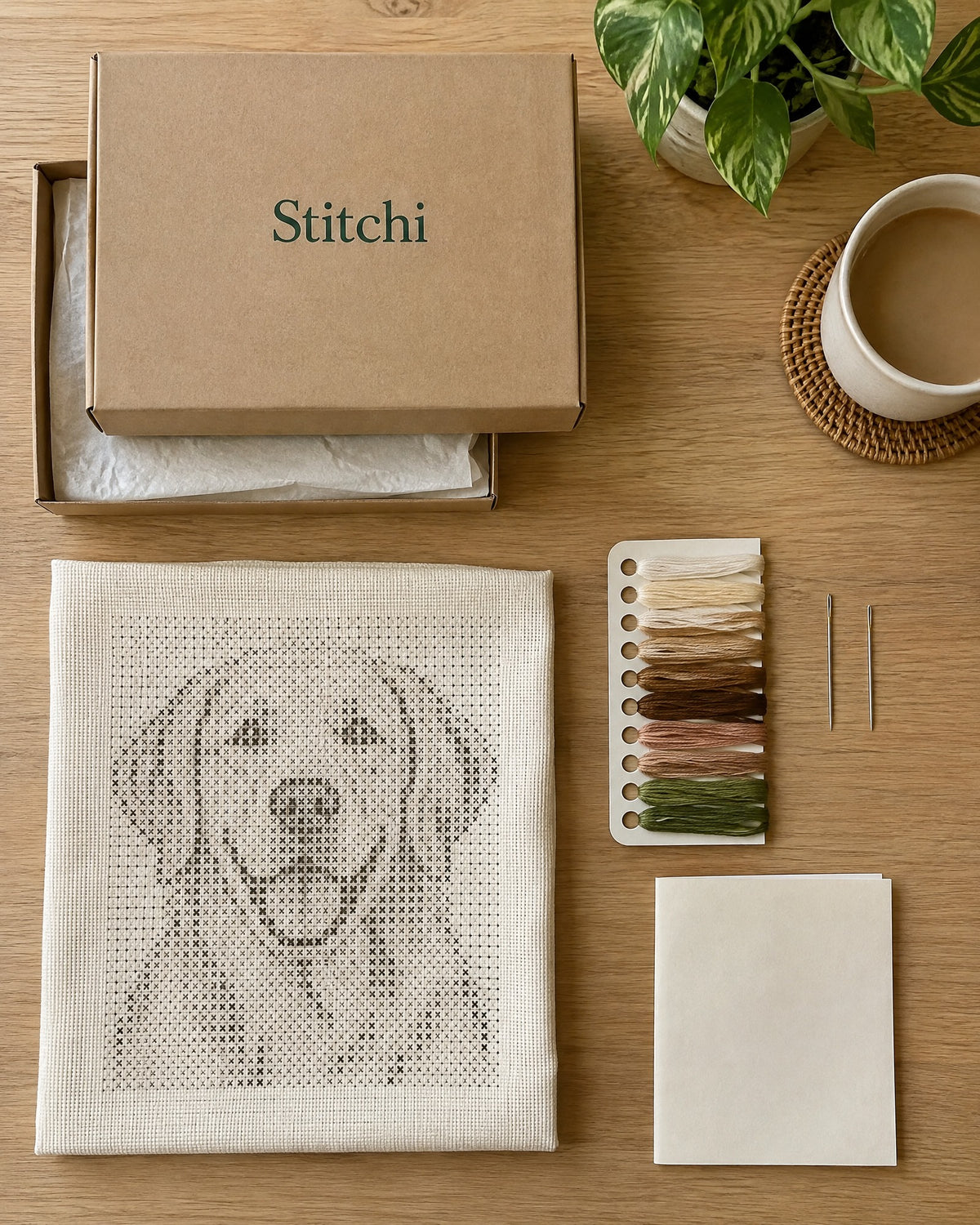
For our own photo cross stitch kits, the workflow:
5×5 cm minimum (an ornament). Below that, detail becomes impractical.
50×70 cm is at the edge of realistic for a single hobbyist project. Larger pieces (1m+) exist but they're multi-year commitments.
Not necessarily. Small projects often pack more density and detail per cm, so they can be harder than a sparse large piece. Choose based on the design complexity, not just size.
Choose a photo you treasure and see your preview straight away. We’ll turn it into a complete Paint by Numbers kit.


Frozen canals, skaters, windmills in the snow and a koek-en-zopie on the ice. A guide to the Dutch winter cross stitch kits and Paint by Numbers designs, and what you are actually...
How the two-canvas duo set works, how to choose between up to 20, 30 and 40 colours, and which of the 75 Christmas Paint by Numbers designs suits whom.
Choose the motif first, then the size, then the canvas type. A practical walk through the 52 Christmas cross stitch designs, with sizes, what is in the box and what it costs.

