Dutch Winter Cross Stitch: Skaters, Windmills and Snow
Frozen canals, skaters, windmills in the snow and a koek-en-zopie on the ice. A guide to the Dutch winter cross stitch kits and Paint by Numbers designs, and what you are actually...
Featured
 Your Photo – Color by Number$90.00
 Custom Embroidery Kit of Your Photo$54.00
 Urban Charm – Paint by Numbers Set (2 canvases)$108.00
 Rural Dream - Paint by Number Kit (2 canvases)$108.00
 Sunset Dreams - Paint by Number Kit (2 canvases)$108.00
 Girl with a Pearl Earring – Johannes Vermeer – Paint by Numbers$90.00
No-count cross stitch (also called stamped cross stitch) has the pattern pre-printed on the fabric — no counting required. When does it beat traditional counted patterns, and when doesn't it? An honest comparison with pros and cons.
If you've ever picked up a counted cross stitch chart, looked at the symbols, and immediately put it back down — there's an alternative. No-count cross stitch (also called stamped cross stitch or pre-printed cross stitch) skips the counting entirely. The fabric arrives with the full design already printed on it, in color. Each square shows which floss color belongs there. You just stitch.
Sounds like the perfect beginner solution. Is it? In this guide, we compare it honestly against traditional counted cross stitch and tell you which one fits which situation.
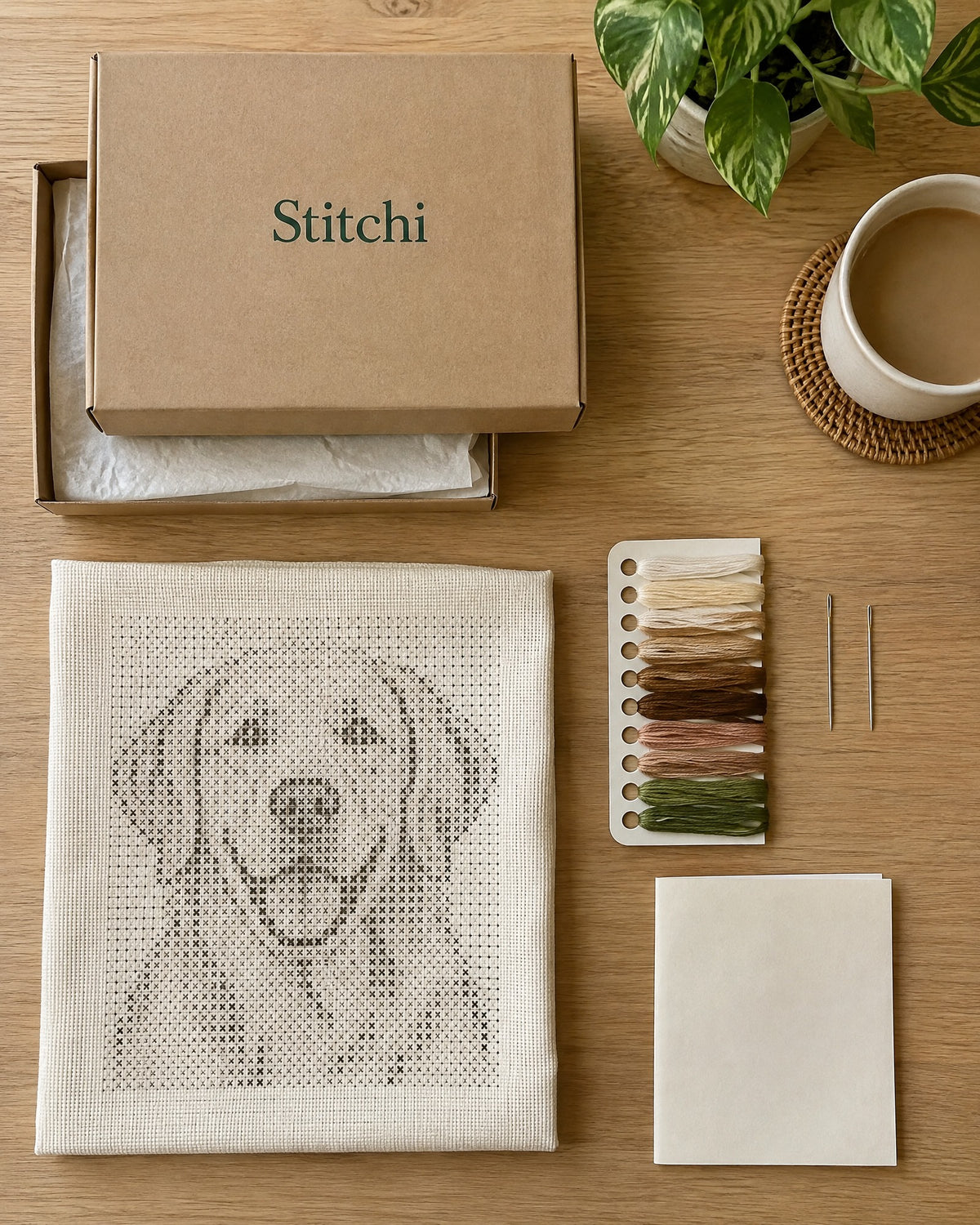
In a traditional counted kit you get blank Aida fabric plus a paper chart. You count squares and "translate" symbols from the chart to spots on your fabric. In a no-count (stamped) kit, that step is gone: the manufacturer has printed the entire design directly onto the fabric, usually in color. Every square shows the floss color that belongs in it.
The Aida is treated with ink or stamped with a template. Once stitched, the colored squares either disappear under your X's, or you wash them out with water.
Pre-printed kits exist mostly in a fixed catalogue of "classic" designs: flowers, animals, religious motifs, children's patterns. Want a specific photo, a modern minimalist design, or something personal? No-count rarely supports that.
Printed Aida is usually a stiffer, rougher fabric because the ink needs something to grip. The finished result feels less refined than classic 14ct or 16ct Aida. Fine for framed wall art — you'll notice it on pillows or heirloom pieces.
On cheaper kits, even after washing, a faint outline can stay visible between your stitches. Not a problem if your design is fully filled in. On designs with empty background, it shows.
A printed square is always slightly larger than an actual Aida cell. As a result, colors on stamped pieces sometimes drift outside the lines, and the finished piece looks less tight than counted on blank Aida.
Honest version: counted patterns teach you chart-reading and spatial reasoning that you'll need for any future project. No-count skips this. If you ever want to scale up to larger or more complex pieces, you'll have to learn counted anyway.
A middle option few articles mention: Aida with a printed grid. Light grid lines mark every 10 squares on the fabric. It's not a complete pre-printed pattern, but it makes counting dramatically easier. The lines wash out after the work is done.
For many beginners, this is the sweet spot: the creative freedom of counted, with much of the comfort of no-count.
| Aspect | No-count (stamped) | Counted |
|---|---|---|
| Beginner-friendly | Extremely | Beginner-friendly with a good guide |
| Design selection | Limited, mostly classic | Unlimited, custom photos possible |
| Fabric quality | Often coarser | 14ct or 16ct Aida standard |
| Finished look | Good, sometimes less crisp | Clean, professional |
| Price | Often cheaper | Comparable to slightly higher |
| Custom photo possible | No | Yes |
| Works at 30×40 cm and up | Limited | No problem |
We work exclusively with counted patterns on quality 14ct or 16ct Aida. Deliberate choice: only counted enables custom photo conversion, gives a sharper finished result, and supports the sizes our customers tend to want (30×40 up to 50×70 cm). Every kit includes clear pattern reading instructions and links to our beginner starter guide so first-timers don't get lost.
Still deciding? Read also starter kit vs custom kit.
Not necessarily, but the printing adds a chemical layer. Properly washed stamped kits last 30+ years, similar to counted. With cheaper kits the ink may fade or thin earlier.
Yes, but test a corner first. Some inks dissolve in water (that's the intent); others stick and require chemical removal. Always follow the kit's specific care instructions.
No. We work exclusively with counted on quality Aida because that enables custom photo conversions and produces a cleaner finished result. For absolute beginners who don't want to read a chart, pre-printed kits are widely available at Hobbii, Bucilla, Dimensions, or on Amazon.
Roughly age 6. Younger kids are better served with plastic canvas or non-stitch crafts.
Yes. Stamped cross stitch, no-count cross stitch and pre-printed cross stitch are synonyms — different names for the same concept.
Choose a photo you treasure and see your preview straight away. We’ll turn it into a complete Paint by Numbers kit.


Frozen canals, skaters, windmills in the snow and a koek-en-zopie on the ice. A guide to the Dutch winter cross stitch kits and Paint by Numbers designs, and what you are actually...
How the two-canvas duo set works, how to choose between up to 20, 30 and 40 colours, and which of the 75 Christmas Paint by Numbers designs suits whom.
Choose the motif first, then the size, then the canvas type. A practical walk through the 52 Christmas cross stitch designs, with sizes, what is in the box and what it costs.

