Dutch Winter Cross Stitch: Skaters, Windmills and Snow
Frozen canals, skaters, windmills in the snow and a koek-en-zopie on the ice. A guide to the Dutch winter cross stitch kits and Paint by Numbers designs, and what you are actually...
À la une
 Votre photo – Peinture par numéros€54,95
 Eigen Foto Borduurpakket€32,95
 Stadse Charme – Kleuren op Nummer Set (2 canvassen)€65,95
 Landelijke Droom – Kleuren op Nummer Set (2 canvassen)€65,95
 Zonsondergang Dromen – Kleuren op Nummer Set (2 canvassen)€65,95
 Meisje met de Parel – Johannes Vermeer – Kleuren op Nummer€54,95
Mindful cross stitch explained: why embroidery lowers stress, sharpens focus, helps you sleep, and how to build a calming stitching routine.
Last updated: 6 May 2026 — by Stitchi Studio
Mindful cross stitch is the surprise mental-health hobby of the past decade. It's repetitive, quiet, and demands just enough attention to crowd out anxious thoughts — the same neural mechanism that makes meditation work, but with a finished piece of art at the end. People stitch through grief, illness, exam stress, recovery, parenting burnout, and ordinary bad weeks. This piece looks at why it works, what the research actually says, how it compares to traditional meditation, and how to build a calming stitching routine that fits a busy life.
Mindfulness, defined plainly, is paying full attention to one thing in the present moment. Traditional meditation uses the breath as the anchor. Cross stitch uses the count: which square am I in, what color goes here, where does the needle go next.
The work demands just enough mental load to displace background worry, but not enough to feel like real cognitive effort. Stitchers describe falling into a state psychologists call "flow" — absorbed, alert, calm. Time vanishes. Notifications stop mattering. After 30 minutes, you look up and realize you haven't thought about your inbox once.
This is the same mechanism that makes adult coloring, knitting, and bread-kneading calming. What makes cross stitch unique is that it leaves you with a finished object — evidence of your quiet hour you can hang on the wall.
If you've never tried it, our complete starter guide walks through everything from supplies to your first stitch.
Studies on craft and wellbeing are still small but consistent.
Cross stitch hasn't been studied as much as knitting, but every cognitive feature that makes knitting calming is true of stitching too — repetitive bilateral hand motion, low-stakes attention, slow visible progress, no screen.
Note: this is not medical advice. Cross stitch is a hobby that helps with mood, not a treatment for clinical anxiety or depression. If your mental health is suffering, talk to a doctor.
Meditation works. So does cross stitch. They're complementary, not competing.
| Meditation | Cross stitch | |
|---|---|---|
| Anchor | Breath | The count, the chart |
| Posture | Sitting still, eyes closed | Sitting comfortably, eyes on work |
| Time required | 5 to 30 min | 20 min minimum to settle |
| Difficulty starting | High — "I can't quiet my mind" | Low — you just stitch |
| Output | None (the point) | A piece of art |
| Best when | You can sit still | You need your hands busy |
Many people who can't sit still for traditional meditation find cross stitch the perfect alternative. The hands are busy, so the mind has fewer escape routes for anxious chatter. The visual progress feels rewarding in a way silent breath-counting doesn't.
For real benefits, treat cross stitch like a daily practice, not a binge.
30 to 45 minutes a day beats one 4-hour weekend session. Brain chemistry responds to consistency, not duration.
Most stitchers find evening (8 to 10 pm) is the sweet spot. The work pulls you off screens before bed and improves sleep onset. A small percentage prefers morning before email opens. Whichever you pick, do it on autopilot — the routine itself becomes calming.
This is non-negotiable. The whole point is the absence of stimulus. Stitch with music, an audiobook, or silence. Not Instagram.
Project-hopping turns the hobby into a to-do list. Pick one piece, work it through, finish it, then start the next.
The completion is part of the therapy. Mounting your finished piece in a hoop, frame, or pillow closes the emotional loop. The how to finish a cross stitch guide covers all four finishing options.
Cross stitch suits some people better than others. The strongest matches:
It's also a thoughtful gift for someone going through a hard time. Our personalized cross stitch gift ideas piece breaks down the best occasions.
Most stitchers feel a shift within 15 to 20 minutes of a session. The mood-stabilizing effect of regular practice tends to show up after about two weeks of daily stitching.
Often, yes — not as a treatment, but as a wind-down ritual. Replacing the last 30 minutes of phone scrolling with stitching consistently improves sleep onset for most adults.
All three work on the same neurological mechanism. Cross stitch is more structured (count, chart, color match) which suits anxious minds that want a clear task. Coloring is more freeform. Try whichever feels less intimidating to start.
Mistakes are part of the practice. Pulling stitches out (called frogging) is itself meditative — slow, deliberate, no consequence. If you find yourself genuinely upset by errors, you've picked too hard a project. Drop down to a small, simple chart for a while.
Yes, but for maximum mindfulness benefit, stick to instrumental music or silence. Spoken audio occupies the language area of the brain, which crowds out the calm, restful state stitching produces. Save podcasts for routine stitching; save silence for hard days.
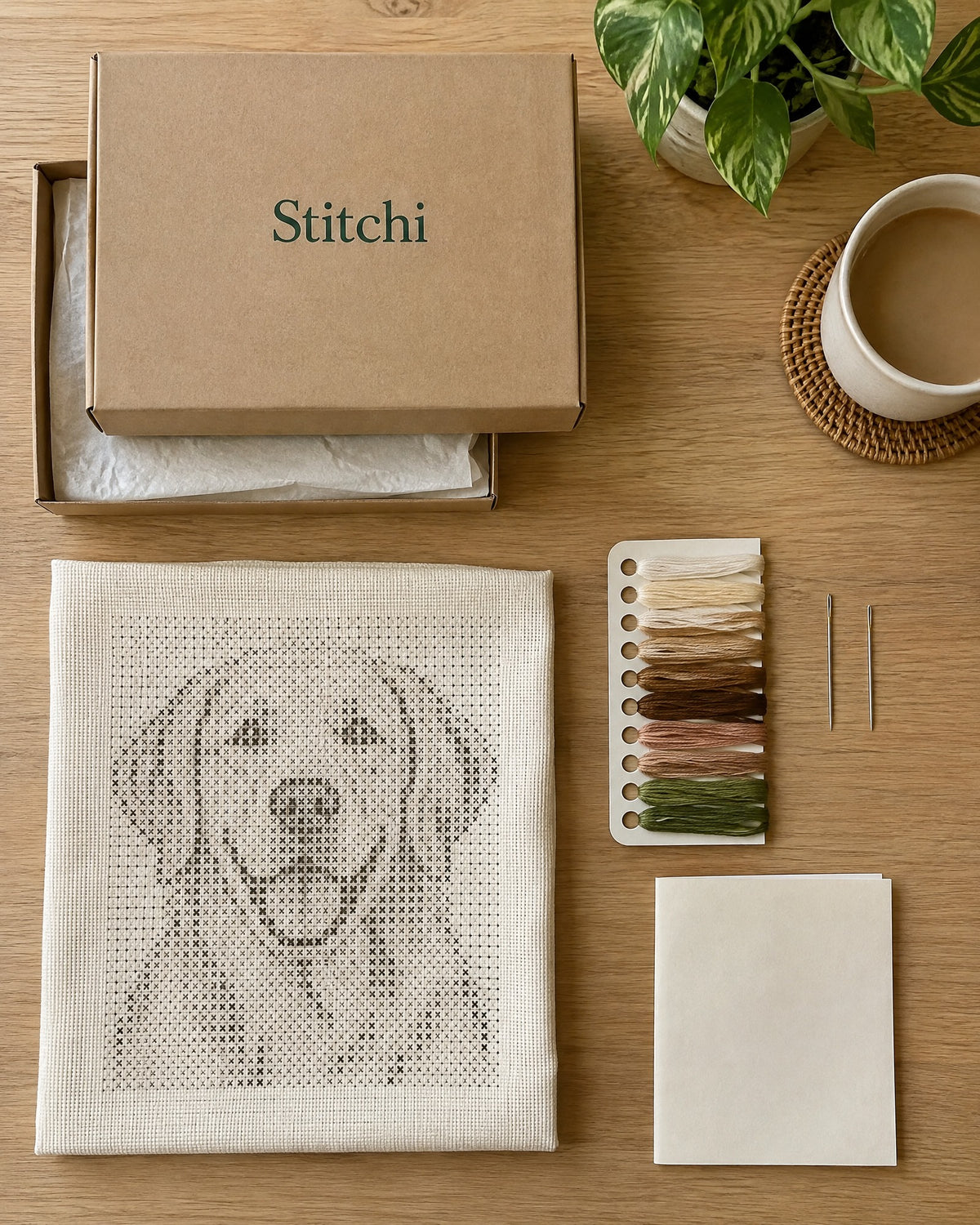
If your goal is mood and mindfulness, start small. A simple 50 x 50 stitch beginner project is enough to feel the effect. For something more personal — a meaningful image to anchor your sessions — our custom photo cross stitch kit turns a meaningful photo into a complete pattern. Pair this with our starter guide and our gift ideas piece if you'd like to share the calm with someone else.
Choisissez une photo qui vous est chère et voyez tout de suite votre aperçu. Nous en faisons un kit complet de Peinture par numéros.


Frozen canals, skaters, windmills in the snow and a koek-en-zopie on the ice. A guide to the Dutch winter cross stitch kits and Paint by Numbers designs, and what you are actually...
How the two-canvas duo set works, how to choose between up to 20, 30 and 40 colours, and which of the 75 Christmas Paint by Numbers designs suits whom.
Choose the motif first, then the size, then the canvas type. A practical walk through the 52 Christmas cross stitch designs, with sizes, what is in the box and what it costs.

